


One of the most impressive stands at Interpack was that of bulk container specialist Schütz, as our video attests, and along with that the company showcased much innovation for the IBC, plastic and steel drum sectors.
To get a feel for the scale of with visual 'wow' factor created on the stand, which was themed 'Containing everything that matters', take a look at this one-minute video first:
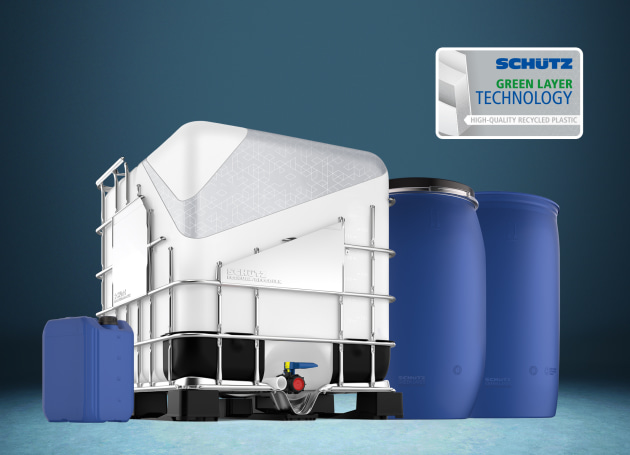
One of the innovation highlights was the much discussed Green Layer series of packaging. For the middle layer of the IBC inner bottles, drum bodies and jerry cans of this product line, Schütz uses 30 per cent high-quality, natural-coloured recycled material, which is recovered through its worldwide collection programme (Schütz Ticket service) for emptied packaging.
Axel Schafer, head of Commercial Product Management and Marketing at Schütz, told PKN that in keeping with this commitment to sustainability, the company has developed further product innovations to help minimise the CO2 footprint of packaging through the use of recycled material.
These include a newly developed, eco-friendly full plastic frame pallet, specially designed for the safe and smooth transport of IBCs in modern automated warehouses.
"Its special geometry makes the pallet suitable for in-house transport on conveyor systems. The full plastic frame pallet is highly durable and is made entirely with recyclate which Schütz collects during the reconditioning of used IBCs in our own recycling centre."
Another point of interest that Schafer shared is that Schütz builds all of its own machinery, so all the packaging it produces is also produced on its own machinery, made at its Selters facility. Here too, the aim is to minimise CO2 footprint, and the company has low-energy consuming machines, while its Selters plant is run on 50 per cent renewable energy.

The 3-skid steel pallet with embossed metal skids is a prototype of another Schütz innovation in the pallet sector. Compared to standard steel skid pallets, it has a new additional middle skid, which greatly enlarges the contact area.
The solution offers optimised weight distribution, it is highly robust and has greatly improved handling properties on conveyor systems, the company says. Due to the high stability and minimised sagging even under full loads, the pallet is optimised for use in high-rack warehouses and automatic transport systems.
PKN will cover more Schütz innovation in the July-August issue.


