


Supermarket giant Woolworths has just published a list of problematic and preferred packaging materials for its suppliers to refer to, based on a traffic-light system of red, amber and green.
In November, 2020, Woolworths launched its 2025 Sustainability Plan, which highlighted its goal to make packaging more sustainable. It is already working closely with suppliers of its own brand packaging to ensure it meets its ambitious commitment to make this packaging recyclable, compostable or reusable by 2023. Its ambitions extend beyond own brand to to include vendor branded packaging, and work with trade partners towards the removal of non-recyclable and hard to recycle packaging materials, in line with the Australian Government’s 2025 National Packaging Targets.
To this end, this week Woolworths has published a problematic and preferred packaging materials list (below) which categorises packaging materials based on how easily recyclable they are, and the company says it will work with all suppliers to phase out the hardest to recycle materials from their packaging by 2025.
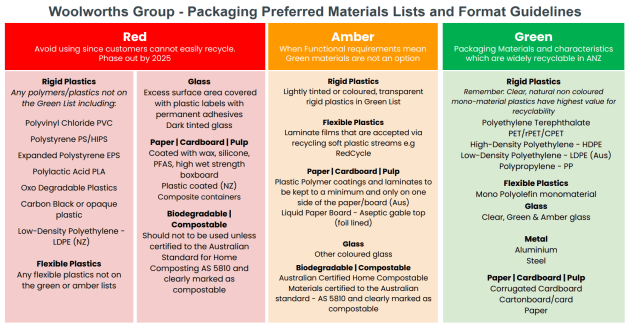
The list was developed in consultation with the Australian Packaging Covenant Organisation (APCO).
Commenting on the step taken by Woolworths, APCO CEO Brooke Donnelly said: “To achieve Australia’s 2025 National Packaging Targets we need a whole of supply chain approach fostering collaboration and leadership. Today, Woolworths displayed both those qualities with the publication of the preferred and problematic packaging materials list. The team at APCO are proud to have developed a number of public resources to support businesses in the transition to a circular economy for packaging and members like Woolworths that share this information with their wide networks can amplify and accelerate this transition.”
In a joint-letter to trade partners this week, chief sustainability officer Alex Holt and Paul Harker, director of buying and group replenishment at Woolworths said: “We are using this list to guide our own packaging and would like to share it with all of our suppliers to support your packaging decisions. We want to work with you to phase out the hardest to recycle materials from packaging by 2025. We hope this practical and easy to understand guide is a helpful tool to identify the materials to be phased out by this time as we work together towards the National Packaging Targets."
“While these may feel like long term goals, it’s important we set this direction with a reasonable timeframe to understand and identify solutions to problematic packaging to reach this target by 2025.”


